

Local Leaders Share Workforce Developments, Small Businesses Honored At Annual Chamber Meeting
Feb. 27, 2026
Local leaders share workforce developments, small businesses honored at annual Chamber meeting
By Brady Hix / brady.hix@daltoncitizen.com
With approximately 360 community leaders, members and local employees taking part in the Greater Dalton Chamber of Commerce’s 85th annual meeting and celebration Thursday at the Dalton Convention Center, several representatives from area businesses, organizations and institutions took part in a panel discussion regarding the growing workforce in Dalton.
Regarding talent development and retention, the discussion featured panelists such as Southeast Whitfield High School Principal Denise Pendley, Engineered Floors’ Employment Manager Ana Linares, Elite Lineman Training Institute Founder and CEO Waylon Hasty, and Sandy McKenzie, the president and CEO of Vitruvian Health’s Hamilton Medical Center. When asked by moderator Stephani Womack about what helps “attract and retain talent” in Dalton, McKenzie said employers and employees alike look for “key attributes.”
“You’re looking for that growing, vibrant community,” she said. “To me, it’s something that people are invested in. They’re wanting to put their homes here. What is the housing and education? What is the system like around education in the community, both at the (kindergarten) through (12th grade) level and at the college level. But in healthcare, people want a place that they can call their home. They want to bring their family here and they want it to be sustainable for their family for the long term. So, I think there’s so many of those pieces. It’s the same things that we hear as we recruit, whether it’s physicians, nurses, or others that come into this community: ‘Tell me about the community; what are the things that are happening? What are the partnerships in the community that will help our business? What’s the workforce? What are we doing to help grow and build that workforce?’” Linares said that focus on retention “has a lot to do with employers investing in the future, which is our youth.” “That means getting in front of those students and showing them the career opportunities that we have here in town,” she said. “Let them know that they don’t have to leave Dalton to have a career path. That comes with retaining our youth here. So, I think that’s important for us employers – getting in front of the schools and creating partnerships so we can show them that they can stay here.”
When asked about how workforce initiatives are evolving to meet those needs, Linares said several initiatives have been vital to growth in town. “I’ve been part of this community for a long time, and I have seen a lot of initiatives from the chamber and the (Dalton-Whitfield Joint Development Authority),” she said. “But I want to talk about two specific initiatives that have helped Engineered Floors to bring talent to the company. One of them is Project Purpose.” Billed as a program “for recent high school graduates not planning to attend college right away and looking for a full-time job,” young members attend a “two-week bootcamp” involving sessions on “soft skills, resume writing, interview techniques, financial literacy, quality control and safety in the workplace,” said Womack. “Students meet, interview and are hopefully hired by one of our local companies at the end of the program.”\
Linares said Engineered Floors has partnered with the program for the past three years.
“We’ve been very lucky to hire significant talent that are still employed with us today,” she said. “We just had FutureFest last week, which is a week(long) event that helped about 3,000 kids. We hired someone from FutureFest; he engaged with our recruiters, we got his information, he applied with us and he’s supposed to start with us next week. So, I think that is very important, just being in front and showing the career opportunities that we offer here. Ten years ago, manufacturing was just a job. Now, it’s a career.”
Looking at how local school systems, postsecondary institutions and employers have partnered throughout the past decade, Pendley said she believes schools have “moved past random career days and guest speakers” to a “true workforce alignment.”
“We have shared responsibility between businesses, industry and education, and it’s been fun to watch the development over the last few years,” she said. “We have worked collaboratively together in that shared responsibility, and it’s intentional in movement and discussions. Some examples of things that we have utilized are student bus tours with (Dalton-Whitfield County JDA Executive Director) Carl Campbell.”
According to Believe Greater Dalton, bus tours are given annually “to local high school students to expose them to job opportunities and quality of life amenities offered in Greater Dalton,” including housing options.
“Those are significant and they make a huge impact on students because it allows them to see what is available here in Dalton for them, whether they’re going off to a typical four-year college or if they’re going straight to work,” Pendley said. “If you have a student who wants to be a chemist, but they don’t know what that looks like in Dalton, those tours provide that, as well as helping students who want to go straight into work. It allows them to find out what is available to them immediately as soon as they graduate from high school.”
Pendley said the partnership between schools and local employers have also made way for annual Rising Professionals seminars, which usually take place in October.
“It’s a great event,” she said. “Seniors participate in this event and every senior completes an interest survey. Then as they arrive, they attend certain sessions that align with their interests and it’s very engaging for students. They ask questions and it’s authentic. They learn through that experience what is available and what pathways to take to get to their goals.”
McKenzie said working with area schools and colleges from a healthcare standpoint has been beneficial as well.
“The sooner we can get in front of those individuals and those students to let them know they can take part in different careers, regardless of the industry, the better,” she said. “Some people think when coming into healthcare, they’re either going to be a nurse or a doctor, but there are so many things. We need engineers, IT professionals and marketing professionals. There’s just so many things. Sometimes you find your way and your path through those programs by having the opportunity to be exposed to different careers there as well.”
When focusing on the Elite Lineman Training Institute – a pre-apprenticeship lineman school in Tunnel Hill – and newcomers from outside of Dalton who go through the 11-week program, Hasty said he has seen students’ perceptions of the town change over the years.
“We have some students enrolled right now from Washington, Vermont, Maine and Pennsylvania, and what’s been incredible about that is, over the last seven years, not only have we got to see them, we get to meet their families,” he said. “And some of them will come here through our program and they want to dig their heels in and move their families to this area. When I ask them, ‘Why are you staying here?,’ the consensus is they like the concept of a small town feel. Not only that, but the diversification of all things around this town as well. These guys are going to play pickleball, they’re hiking, they’re taking a family to different things in Dalton. And that’s from the students and the parents that don’t live in or are not originally from here. We get to hear that unique message and it’s incredible.”
Linares said she is proud of Dalton’s diverse community.
“Years ago, Dalton was just seen as the ‘Carpet Capital of the World,’” she said. “And don’t get me wrong, that is very important. It’s part of our history; we should all feel proud of that. However, I feel like now we have a diverse community. We have different cultures, different languages, different food – and newcomers see that. They want to feel part of that community. They want to come to a place where they can belong and feel supported by everybody, and I love seeing that. I walk downtown and I can choose any kind of restaurant that I want to eat at, different types of foods. So, I feel like that’s important – just bringing different cultures to town. That helps us in the workforce as well. When you start a new job and you’re able to communicate with different people in your language, that is very important for our whole community.”
McKenzie said developments in downtown Dalton and the city itself regarding walkability, connectivity and a strong sense of community has been vital to the future.
“A healthy, active lifestyle is something we all need to strive towards,” she said. “And the work that’s happened in downtown Dalton over the last 10 years has just been remarkable. Growing up in this area and seeing what that has looked like over that time, the number of restaurants and shops, all of these things are just massive economic growth indicators for this community and this area. And it really just continues to help breed growth. As you start to raise the bar, more people want to come and join. And the more you have to come and join is even better. One of our programs includes walkabouts in the town, and it just gets people out to see the town, whether it’s downtown or places like Civitan Park. But those are the things that help bring the community together. It helps to connect us as people, but also it promotes getting outdoors and doing the things that you need to do to help provide that self-care for yourself as well.”
She said housing choices across all stages of life are vital for retention in the community as well.
“It means a tremendous amount,” she said. “Of our 2,800 employees (at Vitruvian Health), 1,200 do not live in this community. To me, I equate being through this community with retention. If you’re here, if you work close to home, you’re more than likely going to stay where you’re at from an employment perspective. But just as another example, six years ago we decided we were going to embark upon our own workforce development in creating and developing a residency program. That was vitally important to us because we knew, in order for us to have the physicians of the future, we needed to take part and have a role in creating and identifying those physicians. One of the key things that came out of that in the beginning is we had to have a place for those young people to live, because they need to live close to the hospital and they need to live in this community because of the shifts and the hours that they are working. A lot of people said, ‘Why is (Vitruvian) building apartments? We knew that we had to have housing for those individuals. So, we did find a developer to partner with…and today there’s 218 apartments there and 90% of those are occupied. So, that just shows the impact and what that can have in this community as well.”
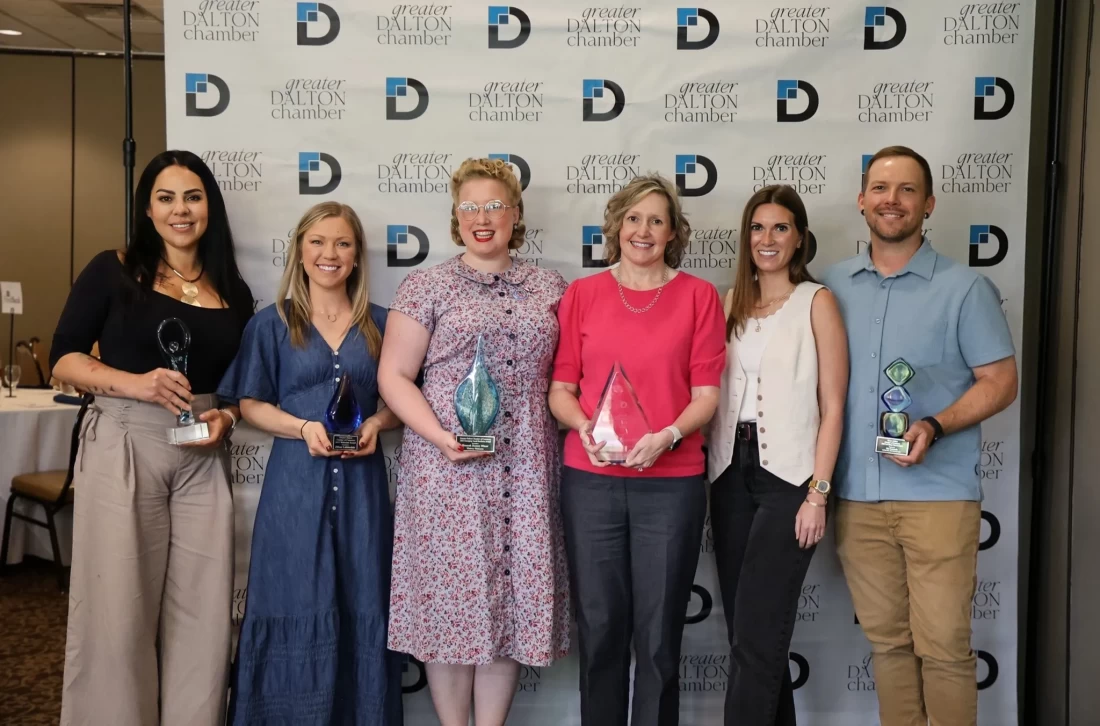
Along with the panel discussion, several local business owners were honored as the Chamber’s 2025 Small Business Award winners. This year’s winners included Block 79’s Viviana Ramirez, Garmony House’s Jillian Lidderdale, Victory Skincare’s Hannah Ramey Minor, JBM Office Solutions’ Kristie Gazaway and local filmmakers Whitney and Brandon Cawood, whose recent documentary “To Dye For” investigated health risks and impacts of synthetic food dyes. “These are the people building momentum, solving problems, creating jobs and adding heart to our community,” said Shaw Industries’ Deanna Mathis, who served as the Greater Dalton Chamber of Commerce’s 2025 chair. “Each (winner) represents something different, but together (they) tell the story of greater Dalton. (They) represent a long tradition of local entrepreneurs with both grit and creativity. (They’re) not waiting for the future to arrive, (they) are building it. Thank you all for everything that you contribute to our community.”
ADD TO REPORT
As you navigate our website, you can use the “Add Item to Report” button to add any page or property to a custom report that you can print out or save.